
Change depends on individuals
Important build and lifecycle work relies on undocumented knowledge or scripts understood by one person.
Governed Infrastructure Execution
Opifex is Praetorian's developing control plane for defining, executing and verifying infrastructure change through governed workflows rather than disconnected scripts and manual steps.

The decision
Infrastructure work is often spread across scripts, consoles, ticket notes and individual knowledge. A task may be repeatable in theory while its authority, inputs, checks and outcome remain difficult to prove.
Opifex is being developed to place an explicit control plane around that work. Approved templates, pre-checks, recorded runs, verification and retained activity provide a governed path from intent to execution.
Common triggers
Important build and lifecycle work relies on undocumented knowledge or scripts understood by one person.
Tasks can be executed, but approval, scope, evidence and rollback expectations are not consistently enforced.
Systems are deployed without a dependable baseline, creating avoidable differences in performance, security and supportability.
A ticket may say that work completed while the checks, evidence and resulting state remain scattered across several systems.
What Praetorian does
Define approved templates, required inputs, authority and pre-checks before infrastructure is created or changed.
Structure adoption, configuration, verification and decommissioning as visible, accountable runs.
Apply known engineering standards consistently and expose systems that have been introduced outside the agreed baseline.
Retain the actor, action, resource, run state and result so that operational change can be reviewed and supported.
Opifex control plane
Opifex is a distinct Praetorian platform under active development. It is intended to govern infrastructure execution: defining what may be built or changed, controlling who or what may initiate the work, checking the environment and recording the result.
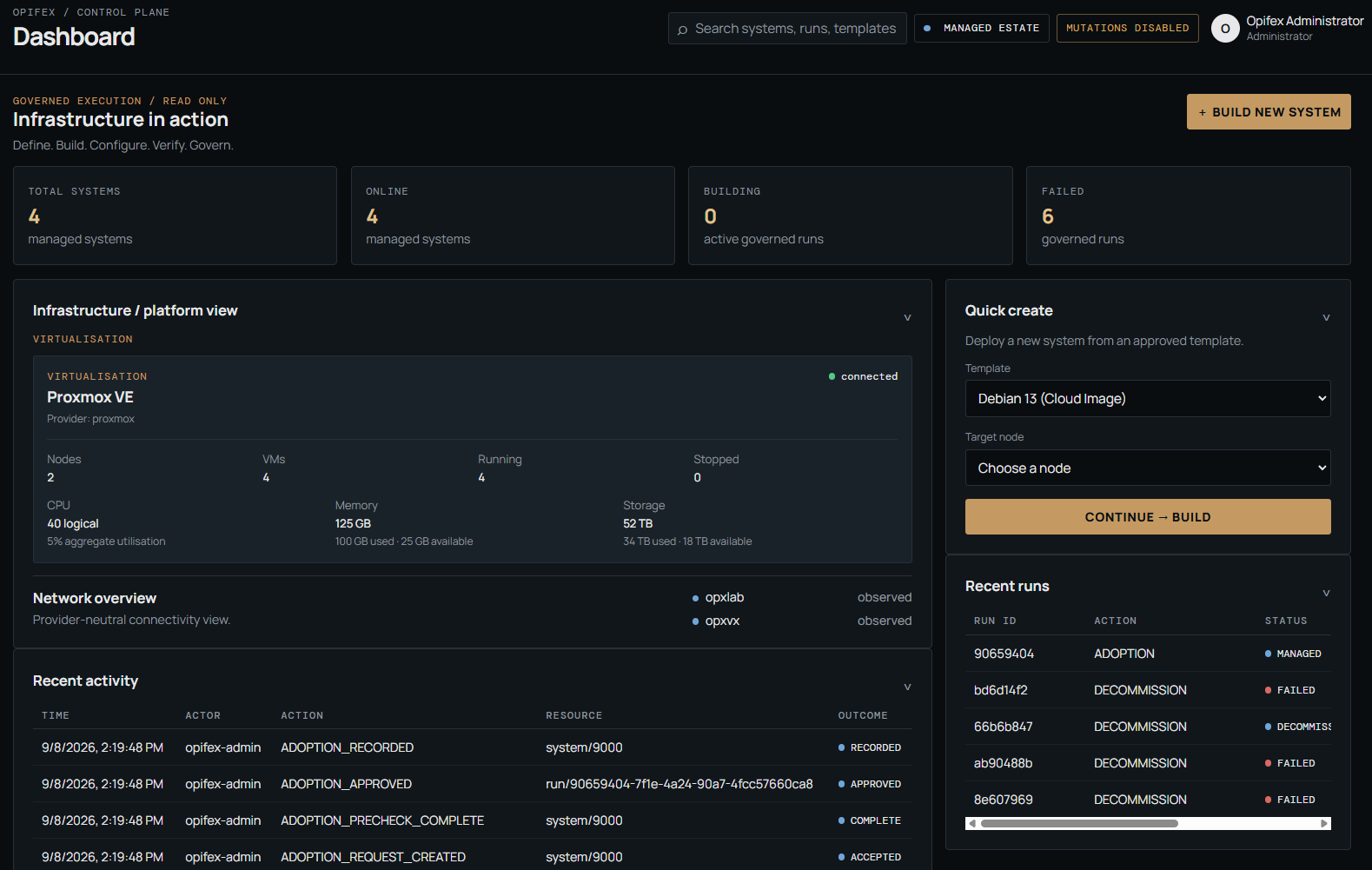
The current interface demonstrates the operating model rather than a finished general-purpose automation product. Managed systems, approved templates, run states and an activity trail make control visible. The development view shown here is deliberately read-only, with mutations disabled.
Opifex can use operational understanding when it is available, including insight produced through Principia, but the platforms remain separate. Principia explains the governed state of the environment; Opifex governs authorised action against it.
Describe approved systems, templates, inputs and expected baselines.
Make permission and execution state explicit before change is allowed.
Run controlled build, adoption, configuration and lifecycle workflows.
Check preconditions and outcomes instead of assuming that task completion proves success.
Retain run status and activity so the change remains traceable after the operator leaves.
Engagement model
Establish the system, baseline, permitted actions, inputs and required evidence.
Confirm authority, scope and preconditions before execution begins.
Run the governed workflow with its state and outcome made visible.
Test the result, retain the evidence and surface any failed or incomplete action.
Technical scope
Why Praetorian
Relevant thinking
Start the conversation
Bring a build, adoption, configuration or lifecycle process that currently depends on manual steps or individual knowledge. Praetorian will help define the authority, baseline, checks and evidence it should require.