- Capability
- Predictive storage assurance
- Signal
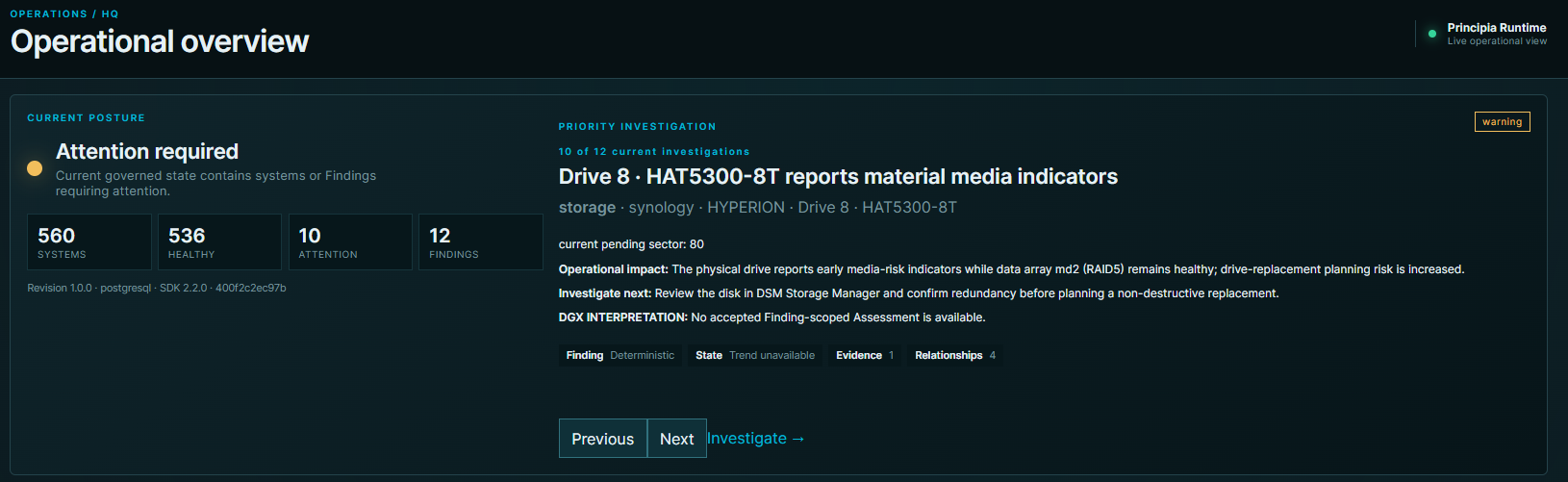
- 80 current pending sectors on a governed drive
- Assumption
- A healthy RAID state meant every disk was healthy
- Outcome
- Prepare a controlled replacement while redundancy remains intact
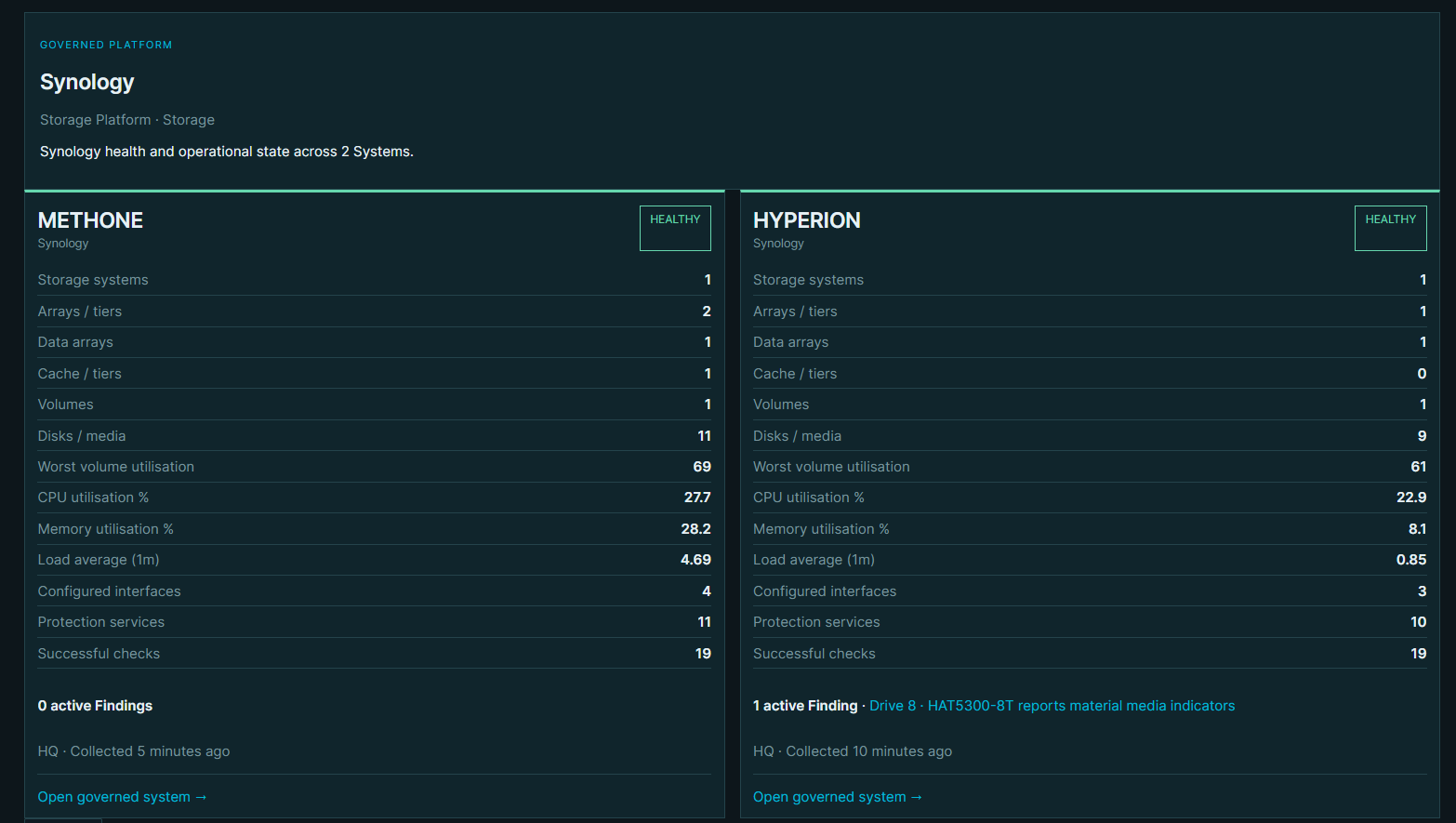
A storage platform reported a healthy array. At the service level, that status was correct: the array remained available, redundancy was intact and users had not experienced an outage.
The aggregate status concealed a more specific condition. One physical drive was reporting 80 current pending sectors. The platform had not failed, but the media was producing an early indicator that should change how the next failure was prepared for.
This is where vendor-level health can become too reassuring. An appliance necessarily summarises many components into a supportable platform state. That roll-up answers whether the system is operating now. It does not always answer whether every underlying component is behaving normally or how much preparation time remains.
An OEM label adds another layer of abstraction. Principia evaluates the exposed hardware identity, device-family context and physical media telemetry alongside the appliance status. This preserves the component detail needed to make a sensible operational decision.
A pending-sector count does not prove that a disk will fail at a specific time. Replacing a drive immediately without checking the array could create more risk than it removes. The signal does justify investigation: verify current redundancy, confirm that recoverable backups exist, review the drive in the native storage manager and prepare a non-destructive replacement.
Early warning gives the team time to source a replacement drive, agree a maintenance window and check recovery before a second fault turns a component warning into a service incident.
Operational intelligence separates current availability from emerging risk, allowing the organisation to act while it still controls the timing.
Principia evidence
Principia is Praetorian's private, AI-supported operational source of truth. It brings governed evidence, system relationships, deterministic findings and assisted interpretation together to provide traceable operational insight.
Principia keeps the platform state and the component evidence visible at the same time. The Synology estate remains operationally healthy, while the governed drive finding identifies material media indicators and recommends validation before a planned replacement.
Engineering lessons
- A healthy array describes current service state; it does not guarantee that every physical disk is healthy.
- OEM platform status should be considered alongside underlying device identity and media telemetry.
- Predictive signals should create preparation and validation, not an unplanned destructive intervention.
- The best time to verify redundancy, recovery and replacement procedure is while the platform remains available.
Read the engineering principles behind this work →
Confidentiality: Engineering Notes are based on real engagements. Client identities, timelines and identifying details may be changed to protect confidentiality. The engineering decisions and lessons remain representative of the work undertaken.